July 6, 2026
How Being Found Online Actually Works
A plain-English guide to SEO, Google Business Profile, and Analytics: what they are, why they take time, and what the real work actually costs.
If you’re considering a website (or you already have one and are thinking about SEO or ongoing marketing) you’re going to run into a lot of buzzwords, mysterious price tags, and vendors making promises they can’t keep.
This is my honest attempt to explain what actually goes on behind the scenes when your business shows up (or doesn’t show up) in a Google search. My goal isn’t to sell you anything. It’s to help you make an informed decision about where to put your money, whether that’s with me, someone else, or nowhere at all.
Read this before you sign any proposal, mine or anyone else’s. You’ll ask sharper questions and get better answers.
What actually happens when someone Googles you
Let’s start with the basics of how Google works. When someone types “tree service near me” or “attorney in Overland Park,” Google does not run out and check the whole internet in real time. It searches an index: a pre-built database of every page it has ever discovered, categorized by what those pages are about.
Here’s the actual sequence:
-
Google’s crawler (a program called Googlebot, Google’s own documentation is here) visits every page on the internet on a rotating schedule. Popular sites get crawled often, sometimes multiple times a day. Small business sites get crawled less often, sometimes once every few weeks.
-
When Googlebot visits a page, it indexes it. That means it reads the content, categorizes the topics, notes the structure, and files it in Google’s database.
-
When someone searches, Google matches their query against the index and picks the best few results based on hundreds of ranking factors. Some of the biggest: content quality, how well the page matches the query, page speed, mobile friendliness, how many other trustworthy sites link to it, and how users behave when they land on it.
-
For local searches (anything with “near me,” a city name, or search intent that implies location) Google also pulls in Google Business Profile data, review counts, physical proximity to the searcher, and business categories.
The key insight most business owners miss:
Your website is not “seen” by Google instantly. When you launch a new site or publish a new page, it typically takes days to weeks for Google to discover it, crawl it, and add it to the index. Ranking well takes longer, usually months, because Google needs time to gather signals about whether the content deserves to rank.
This is why every honest SEO conversation includes the phrase “it takes time.” Not because the vendor is stalling. Because it genuinely takes time.
Concrete example from work I’m doing right now: I built and launched onelinnvalley.com on July 4, 2026, a community hub site for my hometown of Linn Valley, Kansas. I set up GA4 and Google Search Console the same day. As of this writing, three days into the site’s life, Search Console shows Google is crawling and indexing the pages, but nothing’s ranking for target queries yet. That’s expected. In three months I’ll have real ranking data. In six months, meaningful traffic patterns. In a year, I’ll know whether the SEO strategy for that site actually worked. This is normal. Every new site goes through this. Anyone who promises you faster hasn’t run their own real project.
SEO: what it actually is
SEO stands for Search Engine Optimization. It’s the umbrella term for all the work involved in making sure Google understands your site and shows it to the right people.
There are two flavors, and both are needed:
Technical SEO
This is the plumbing. It’s all the behind-the-scenes work that makes sure Google’s crawler can visit your site, understand it, and process it correctly. If technical SEO is broken, nothing else matters. Google can’t rank a site it can’t crawl.
What actually goes into it:
- Site structure and navigation. Google needs to be able to follow logical paths from your home page to every other page.
- Page speed. Google penalizes slow-loading pages. Sub-2-second load times are the standard.
- Mobile responsiveness. 60%+ of Google searches happen on phones. A site that doesn’t work well on mobile ranks worse for everyone.
- Schema markup. A specific structured-data format that helps Google understand context. When you see a rich search result (like a recipe with star ratings, or a business hours block), that’s schema in action.
- Meta tags. Page titles, descriptions, and other invisible metadata that tell Google what a page is about.
- Internal linking. How pages on your site link to each other, telling Google what’s important.
- Sitemap generation and submission. An XML file that lists all your pages so Google can find them.
- Fixing crawl errors. Broken links, redirect loops, indexing problems that come up over time.
How long the initial technical SEO setup takes: typically 8-15 hours of skilled work, depending on the state of the existing site.
Content SEO
This is the visible part: the words on your pages, the topics you cover, how well they match what real customers search for.
What actually goes into it:
- Keyword research. Figuring out what your ideal customers are actually typing into Google. Not what you think they type. What they really do.
- Competitor analysis. Looking at what content ranks for the terms you want, and identifying gaps.
- On-page optimization. Writing page titles, headings, body text, image alt tags, and internal links that align with target keywords.
- Content strategy. Deciding what to publish, when, in what order, and why. Not random blog posts. Deliberate ones.
- Actual content creation. Writing blog posts, service pages, FAQs, and other content that answers real customer questions.
How long content SEO takes to show results: 3-6 months minimum, often 6-12 months for meaningful ranking gains, because:
- Google needs to recrawl and reindex updated content
- New content has to compete against established content that Google already trusts
- Ranking algorithms evaluate over time, not on a single crawl
- Trust signals (backlinks, user engagement, brand mentions) accumulate slowly
Anyone who promises you first-page Google rankings in 30 days is lying to you. SEO doesn’t work that way. It has never worked that way. Anyone claiming it does is either using shady techniques that will get you penalized, or they’re just lying to close the sale.
Google Business Profile: the local search engine
For most small businesses, Google Business Profile (GBP) matters more than your website SEO. When someone searches “tree service near me” or “coffee shop Overland Park,” what shows up first is a map with three business listings: the “map pack” or “local pack.” Those three businesses get most of the clicks. Your website results come below that.
Getting into the map pack requires a fully optimized GBP.
What GBP actually is
GBP (see Google Business Profile Help for Google’s own documentation) is Google’s business directory. Every business has a listing whether they’ve claimed it or not. When you “claim” your GBP, you gain the ability to edit and manage it. The listing shows up when someone searches for your business by name, and it powers your appearance in local searches for your services.
What optimizing GBP involves
There are over 100 optional fields on a GBP listing. Each one that’s filled in correctly makes Google more confident in ranking you.
Setup work:
- Verification. Proving you own the business. Usually a postcard mailed to your address with a code, sometimes phone or video verification.
- Business categories. Picking the primary and secondary categories. Getting these wrong tanks your local rankings.
- Business info. Hours, service area, description, attributes, website URL, phone number, address.
- Services list. Every service you offer, listed individually with descriptions.
- Products. If applicable, with photos and descriptions.
- Photos. Google favors profiles with 10+ high-quality photos. Interior shots, work-in-progress, finished projects, team photos, exterior shots.
- Q&A seeding. Publishing common questions and answers on your profile.
Ongoing work:
- Google Posts. Like short social media posts, but on your GBP. Every 7-14 days keeps the profile fresh.
- Photo uploads. A steady drip of new photos signals an active business.
- Review management. Responding to every review, especially negatives, within a few days.
- Q&A monitoring. Customers can post their own questions on your profile. If you don’t answer, someone else (a competitor, an angry customer) might.
- Attribute updates. Google adds new attribute categories periodically (like “curbside pickup,” “veteran-owned,” “wheelchair accessible”). Keeping these current matters.
Why this takes ongoing time:
- Google Business Profile ranking algorithms favor freshness signals. A profile that hasn’t been touched in months gets deprioritized.
- Reviews decay in weight over time. A review from three years ago counts less than one from last week. You need a steady stream of new ones.
- Customers watch your responses to reviews. Bad responses (or missing responses) cost more customers than the original bad review did.
- Local competition changes constantly. A competitor optimizing their profile can push yours down.
Time to establish real authority: 60-90 days after full optimization for meaningful local ranking movement. Faster than website SEO because there’s less content to evaluate, but still not instant.
Google Analytics 4 (GA4): the measurement layer
You cannot improve what you cannot measure. That’s what analytics is for.
GA4 (Google’s own documentation is here) is Google’s current analytics platform (it replaced Universal Analytics in mid-2023). Without it, you have no idea:
- How many people visit your site
- Where they come from: search, social media, direct traffic, referrals
- What pages they visit and how long they stay
- What they do: click your phone number? Fill out a form? Bounce immediately?
- What actually converts them into leads or customers
What setting up GA4 involves
- Property creation in Google Analytics
- Data stream configuration. Connecting the analytics account to your specific website
- Tracking code installation. Adding a small JavaScript snippet to every page
- Custom event tracking for the actions that actually matter to your business:
- Phone number clicks (people calling from mobile)
- Email clicks
- Form submissions
- Booking or “get quote” button clicks
- PDF downloads (if applicable)
- Goal / conversion configuration so Google knows which events are “leads” vs. general engagement
- Integration with Google Search Console so you can see what search queries brought people to your site
- Google Ads integration if you’re running ads
- Cookie consent banner if you’re serving traffic from Europe (GDPR requirement) or California (CCPA requirement)
Setup time: usually 3-6 hours of skilled work, more if the site has complex tracking needs.
The ongoing analytics work
Setting up analytics is only the first step. Actually using the data requires ongoing analysis:
- Weekly or monthly review. What’s driving traffic? What isn’t?
- Underperforming page identification. Pages people bounce off quickly are candidates for rewriting.
- Anomaly detection. Sudden traffic drops or spikes need investigation (algorithm changes? technical issue? news event?).
- Content strategy adjustment. Using data to inform what to publish next.
- Reporting to you. Plain-English monthly or quarterly summaries so you know what’s happening.
Time until data becomes reliable: 30-90 days of collection. Below 30 days, sample sizes are usually too small to trust patterns.
How SEO, GBP, and Analytics work together
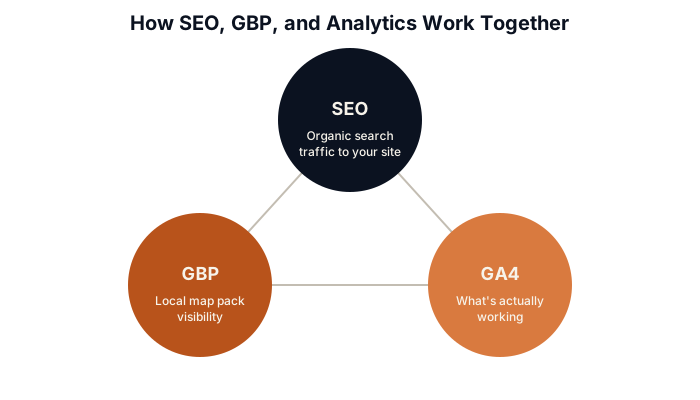
These three are not separate services. They’re three sides of the same triangle.
- GBP gets you visibility in local search results (the map pack).
- SEO brings organic traffic to your website from broader searches.
- GA4 tells you what’s actually working, so you can double down.
None of them work well in isolation:
- Great SEO + weak GBP = you show up for broad searches but lose the map-pack traffic that converts best.
- Great GBP + bad website = people click through, land on something amateurish, and leave.
- Great content + poor analytics = you can’t tell what’s working, so you optimize the wrong things.
Doing all three well is what “digital marketing for a local business” actually means. Skipping any one of them limits the results of the others.
Why does it cost what it costs?
Let me be transparent about the actual labor involved. These aren’t marketing numbers. They come from tracking my own time on actual SEO projects, including the site you’re reading this on (windwalkerstudio.com) and the community site I mentioned earlier (onelinnvalley.com). Setup ranges vary based on how much already exists that needs cleanup versus starting from scratch. Monthly ranges vary based on how much content the client wants published.
Initial setup (one-time)
| Task | Hours |
|---|---|
| Keyword research and competitor analysis | 5-8 |
| Technical SEO audit and fixes | 4-8 |
| On-page optimization of existing pages | 4-6 |
| Service-area landing pages (per page) | 4-8 |
| Google Business Profile full setup and population | 3-5 |
| Initial citation submissions (Google, Bing, Yelp, Facebook, Nextdoor, and 3-5 industry directories) | 2-3 |
| GA4 setup, event tracking, goal configuration | 3-5 |
| Google Search Console setup and sitemap submission | 1-2 |
| Documentation, handoff, training | 1-2 |
| Total: initial setup | 27-47 hours |
At industry rates ($75-$150/hr for skilled SEO work), that’s $2,000 - $7,000+ in labor just for the initial setup, not including ongoing service.
Ongoing monthly work (per client)
| Task | Hours/month |
|---|---|
| Technical monitoring, error checking, uptime | 1-2 |
| On-page optimization based on new data | 2-4 |
| Content updates (existing page tweaks) | 1-2 |
| Blog post writing and publishing (1 post) | 3-5 |
| Google Business Profile posts and photo uploads | 1-2 |
| Review response and Q&A management | 1-2 |
| Analytics review and reporting | 1-2 |
| Client communication and strategy | 1-2 |
| Total: monthly ongoing | 11-21 hours/month |
At industry rates, that’s $800-$3,000+ per month in labor.
Most agencies charge $750-$5,000/month for full SEO service. When you see a package for less than $500/month, either they’re using automated tools that don’t actually work, or they’re spending less than 10 hours a month on your account. Neither produces results.
Why I can offer competitive rates
Wind Walker Studio is a small practice. No account managers, no sales team, no fancy office, just me doing the work directly. That structural efficiency means I can offer full-service SEO at the low end of the market rate ($275-$750/month depending on your package and location) without cutting corners on the actual work.
Why consistent execution matters more than occasional bursts
“I’ll just have someone do it every few months when I remember.”
I hear this a lot. It doesn’t work.
Here’s why:
- SEO gains compound but also decay. Every month of consistent work builds ranking authority. Missing months means competitors pass you.
- Blog content works in aggregate. One post ranks for 5-10 keywords. Twelve posts a year? 60-120 target keywords, some of which will hit. Skipping months = giving up that compounding.
- Google Business Profile freshness matters. Profiles that go silent for weeks get downgraded. Fresh posts, photos, and reviews signal an active business.
- Reviews decay in weight. A steady drip of new reviews (2-4/month) maintains your rating authority. Long gaps mean older reviews carry less weight and your position slips.
- Your competitors don’t stop working. Even if you had perfect SEO today, they’re publishing new content, adding photos, getting reviews, updating their profiles. Every day you don’t work on yours, they gain ground.
The right mental frame: this is like maintaining a garden, not building a piece of furniture. A dining table stays a dining table. A garden that isn’t tended goes back to weeds. Digital marketing is a garden.
What honest SEO timelines look like
Real ranking movement follows a fairly predictable pattern:
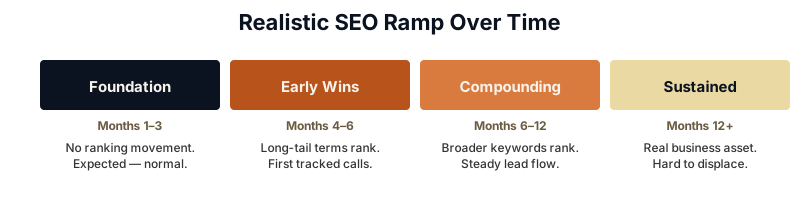
- Months 1-3 (foundation): Site indexed, GBP fully populated, first blog posts published, technical baseline solid, analytics collecting data. You will not see meaningful ranking movement yet. This is normal.
- Months 4-6 (early wins): Long-tail keywords start ranking (specific multi-word searches like “emergency tree removal Overland Park”). First tracked lead calls typically show up in month 4 or 5.
- Months 6-12 (compounding): Broader keywords start ranking. Traffic curves start turning upward. Consistent lead flow becomes measurable.
- Months 12-24 (compounding accelerates): Domain authority builds. Content that was “OK” starts ranking better. Content that was already ranking climbs higher.
- Year 2+ (sustained): Your site is a real asset. Consistent inbound traffic and leads. Competitors have to work hard to displace you.
If you cut SEO off at month 6 or 12, momentum drops fast. The compounding stops. Rankings that took a year to build can be lost in 3-6 months of inaction.
That’s why my minimum recommendation is a 12-month engagement. Anything less doesn’t give the work time to actually compound.
What Wind Walker Studio does about this
For a deeper look at SEO specifically for professional practices (attorneys, accountants, medical), see my earlier post: How SEO Actually Works for Professional Practice and Small Business Websites. That one is shorter and more focused on the professional-practice case; this one covers the broader picture including GBP, GA4, and pricing transparency.
If you decide to work with me, here’s what Care+SEO covers:
- All setup work listed above, delivered upfront so the foundation is solid before ongoing work begins
- Monthly blog post written in your voice on topics that rank for your business (I write it, you approve it, it publishes)
- Monthly on-page SEO tuning based on what’s working and what isn’t
- Google Business Profile management. Posts, photos, Q&A, review responses
- Local citation maintenance. Keeping your business info consistent across the directories that matter
- Analytics reporting. Quarterly plain-English summary of what’s happening, what’s working, what’s next
- Direct access to me. No account managers, no ticketing system, just email or text
Public rate: $750/month. Small businesses in KC metro that need real SEO but aren’t ready for a five-figure investment are the sweet spot for a Care+SEO engagement.
What to do next
If you’re considering working with me (or with someone else) here’s what I’d suggest:
- Ask what the timeline actually looks like. If someone promises fast rankings, walk away. Real SEO takes 3-6 months minimum to show results.
- Ask what’s actually included. Get the itemized list: how many hours per month, on what tasks, and what the reporting looks like. Vague promises are red flags.
- Ask about their approach to Google Business Profile. For local businesses, this is the highest-ROI activity. If they don’t emphasize it, they don’t understand what your business needs.
- Ask for references. Not just testimonials, actual businesses you can call. Anyone doing good work has clients who’ll vouch for them.
- Read your proposal carefully. Make sure you understand what’s monthly recurring vs. one-time, what the setup cost is, and what happens if you cancel.
If you have questions after reading this (or you’d like to talk through what your business specifically needs) call me or send me an email. Fifteen minutes on the phone is enough for me to tell you honestly whether I’m the right person for your project, or whether you’d be better off with someone else.
No pressure. No sales pitch. Just an honest conversation about what your business actually needs and what it should cost.
Common Questions
How long does SEO take to actually work?
3–6 months for first meaningful movement on long-tail terms. 6–12 months for broader keywords to rank. 12+ months for SEO to become a real business asset. Anyone promising faster is either misleading you or gaming metrics that don't matter for your business.
Do I need to buy Google Ads for SEO to work?
No. Google's organic ranking algorithm and its Google Ads platform are entirely separate systems. Buying ads does not directly help your organic ranking, and skipping ads does not hurt it. Ads are useful when you want immediate visibility for a specific campaign. SEO is what you build long-term.
Why does SEO cost what it costs?
Because it's not a one-time setup. The work is content creation, technical maintenance, keyword tracking, competitor monitoring, and continuous updates as Google's algorithm evolves. The labor is real hours of skilled work every month, not a subscription to a magic tool.
Can I do my own SEO?
Some of it, yes. Google Business Profile setup, basic keyword research, and consistent blog publishing are all learnable. What's hard to DIY is the ongoing time commitment and the technical foundation: page speed, structured data, canonical tags, sitemap hygiene. Most small business owners have neither the time nor the interest, which is why SEO gets outsourced.
Related reading
July 12, 2026
Having a Website Isn't the Same as Being Found
A good-looking website and being findable on Google are two different purchases, and a lot of local businesses only bought the first one. Here's why, and how to tell if it's happening to you.
July 7, 2026
How Reviews Work for Local Business (And How to Get More)
Why reviews rank your business, how to actually get more of them, and what to say when they arrive. Written for small businesses and service trades.
Have a project this connects to? Let's talk about it.