June 30, 2026
How SEO Actually Works for Small Businesses and Practices
Plain-English guide to SEO for law firms, accountants, medical practices, and small businesses. What matters, what doesn't, and realistic expectations.
There are entire agencies built around convincing you that SEO is complicated. Some of it is. Most of it isn’t. If you run a law firm, an accounting practice, a medical office, or a small business, and you want your website to help people find you on Google, here’s what you actually need to know.
What SEO Actually Is
Search engine optimization is a set of practices that make it more likely someone searching for what you offer will find your website in the top few Google results. That’s it. Not magic. Not manipulation. Not hacking Google.
Google’s job is to answer people’s questions well. Their algorithm is trying to figure out which pages actually deserve to be at the top. Your job is to give it every reason to pick yours. Google Search Central is the official starting point. Everything in this post is compatible with what Google itself publishes.
For a professional practice, most people find you through one of three paths:
- They Google your name (branded search, easy to win)
- They Google what you do plus a location: “family law attorney overland park” (local SEO)
- They Google a specific question your service answers: “what does an estate attorney do” (informational search)
Different work goes into ranking well for each.
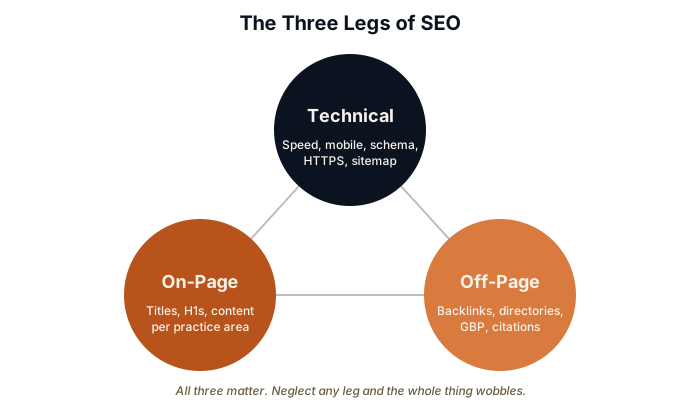
The Three Legs of SEO
1. Technical SEO
The stuff Google’s crawler needs to work with your site properly. If your technical setup is bad, no amount of good content will save you.
What matters:
- Fast page load times (Google’s Core Web Vitals measures this and includes it in ranking)
- Mobile-friendly design (Google indexes mobile-first now)
- Structured data (JSON-LD schema markup that tells Google exactly what your business is)
- XML sitemap and robots.txt (helps Google discover your pages)
- HTTPS with a valid SSL certificate
- Clean URL structure that makes semantic sense
What doesn’t matter much:
- Fancy technical audits from tools that flag 500 “issues” (most are noise)
- Obsessing over keyword density
- Rewriting URLs for old pages you’re changing
Technical SEO is largely a one-time setup for most sites. Get it right at launch, revisit annually.
2. On-Page SEO
The content on your pages and how it’s organized. This is where the biggest wins happen for professional practices.
What matters:
- Clear, descriptive page titles (the
<title>tag) that match what people actually search for - Meta descriptions that make someone want to click when they see your listing
- One clear H1 on each page that matches the search intent
- Content that actually answers what the searcher was looking for
- Contact info visible on every page
- Content specific to each of your practice areas: a page per area, not a bullet list on one generic “Services” page
What doesn’t matter:
- Word count for its own sake (2,000 words of fluff is worse than 500 words of substance)
- Cramming keywords in unnaturally
- Duplicate content warnings from tools when the “duplicates” are your address in the footer
For an attorney, the highest-leverage move is a well-written landing page for each practice area, with the search terms real potential clients actually use worked in, not stuffed.
3. Off-Page SEO (Also Called Backlinks)
Other websites linking to yours. Google reads this as: “Other people vouch for this site.” More votes from trusted sources = higher ranking.
What matters for professional practices:
- Getting listed in reputable directories in your field. For attorneys: Avvo, Justia, FindLaw, state bar directory. For CPAs: your state’s CPA society, national directories. For medical: Healthgrades and similar.
- Google Business Profile (technically not a backlink but the single most important local SEO asset; see below)
- Local news mentions, chamber of commerce listing, and community involvement pages
- Guest articles on legal or industry publications if you’re willing to write
What to avoid:
- Buying backlinks (Google penalizes this, sometimes severely)
- Cheap link-farm services promising “500 backlinks for $99”
- Directory listings on sites nobody visits
Off-page SEO is the slowest part to move. It takes months of steady work.
Local SEO: Where Most Professional Practices Win or Lose
If you serve clients in a specific geography, this is where most of your Google traffic will actually come from.
Google Business Profile. Free, from Google. Claim it, fill it out completely, add photos, request reviews from happy clients. This alone will get you into the “map pack”: the little Google Maps section that shows up above regular results for local searches. For many searches (“estate planning attorney overland park”), the map pack is where the clicks go, not the blue-link results below.
NAP consistency. Your Name, Address, and Phone should be spelled the exact same way everywhere online. Even minor variations (Suite 200 vs. Ste 200) can dilute your local SEO. Pick one canonical format and use it everywhere.
Local content. A page or two that legitimately talks about your community involvement, your address, your service area. Not keyword-stuffed. Legitimate.
Reviews. Ask happy clients for Google reviews. Respond to reviews, including negative ones, professionally.
What Actually Matters: the 80/20
Most professional practices should focus on these six things:
- Google Business Profile: set up and maintained
- One clear, well-written page per practice area or service
- Fast, mobile-friendly site with proper structured data
- A handful of high-quality directory listings (Avvo, Justia, state bar, chamber)
- Consistent Name/Address/Phone across your website, Google Business Profile, and directories
- Ongoing Google reviews from happy clients
Do these six things well and you’ll outrank most of your competition. Everything else is optimization on top.
Realistic Timelines
New site targeting local keywords: 3-6 months to start seeing meaningful search traffic. Competitive metros or high-value terms can take longer.
Anything faster than that is either paid ads (a different game) or manipulation that eventually gets caught and punished.
When You Don’t Need to Worry About SEO
If your business runs entirely on word of mouth and referrals, and you don’t want more inbound leads from search, honestly, you don’t need to obsess about SEO. A basic site that shows up when someone Googles your name is enough.
SEO is worth investing in when:
- You want to grow beyond your existing referral network
- You compete in a market where prospects Google before choosing
- You have a specific service or specialty you want to become known for
The Honest Read
SEO is a compounding investment. Six months of steady work turns into free traffic that keeps coming for years. But it requires patience.
Two things I always tell prospective clients:
-
Anyone promising to guarantee you a #1 Google ranking is lying to you. Google doesn’t work that way, and reputable SEO practitioners know it.
-
Basic SEO is not complicated. The technical work has well-known best practices, and the content work is just writing clearly about what you do. If someone tries to make it sound harder than that to justify a bigger retainer, walk.
If you want to talk about what SEO would look like for your specific practice (where you are now, where you could realistically be in 6-12 months, and what it would cost to get there), get in touch. Fifteen-minute call, no pressure. I’ll tell you honestly if it’s worth the investment for your situation.
Common Questions
Is SEO worth it for a small law firm or professional practice?
For most professional practices, yes, but only if you commit to the long horizon. SEO takes 6–12 months to show meaningful results, and requires ongoing content and technical maintenance. If you need clients in the next 90 days, buy ads. If you want a durable source of qualified leads over the next several years, invest in SEO now.
How much should a professional practice spend on SEO monthly?
Realistic range is $500–$2,000 per month for a solo or small-firm practice, depending on how competitive your market is and how much content you're producing. Anyone offering meaningful SEO work for less than $500/mo is either cutting corners or using an AI content mill that will hurt more than help.
What's the difference between SEO and Google Ads for law firms?
SEO is your organic ranking: the free blue links below the ads. Google Ads is paid placement above them. SEO takes time but compounds. Ads are immediate but stop working the moment you stop paying. Most healthy professional practices use both, weighted toward SEO as the long-term asset.
Related reading
July 12, 2026
Having a Website Isn't the Same as Being Found
A good-looking website and being findable on Google are two different purchases, and a lot of local businesses only bought the first one. Here's why, and how to tell if it's happening to you.
July 9, 2026
When Your Website Is Quietly Costing You Customers
Most websites don't fail loudly. They leak. The signs your site is losing you business, a 10-minute self-test to catch them, and why fixing it pays off now.
Have a project this connects to? Let's talk about it.