July 1, 2026
How Attorneys Should Actually Compare Website Vendors
How solo and small law firms should compare website vendors: national services, boutique agencies, and independent developers. What each costs.
If you’re an attorney looking at your current website (or looking to build a new one) you’ve probably encountered three very different pitches. National marketing services promise a turnkey experience. Boutique agencies pitch premium custom builds. Independent developers offer fixed-bid work.
All three can deliver a functional attorney website. But they operate on very different economic models, and the trade-offs matter a lot depending on your practice.
Here’s a framework for actually comparing them: not by which is “better,” but by which is the right fit for your specific situation.
Three Categories of Vendor
National Legal-Marketing Services
What they are: Large firms that provide template-based websites with ongoing content publishing, hosting, and SEO as a monthly subscription. One-stop shops for law firm marketing.
What they do well:
- Turnkey. Sign a contract and largely walk away. They handle content, updates, and maintenance.
- Established brand and legal-vertical experience.
- Directory network access. Being on their platform often gets you cross-linked into a broader ecosystem.
- Bar-advertising rule compliance is baked into their templates.
- Ongoing content publishing (blog posts, articles, updates) included in the retainer.
What they don’t do well:
- Custom design. Every site on their platform looks similar. Your practice ends up visually indistinguishable from every other attorney on the same platform.
- Real differentiation. Their positioning templates tend toward aggressive-red-and-black or safe-corporate-blue archetypes.
- Site ownership. You lease the site. Leave the service and you have nothing.
- Modern technical foundations. Templates optimize for the vendor’s internal scale, not for your specific SEO, page speed, or accessibility outcomes, all of which now factor into how Google ranks your site.
Cost model: Monthly retainer ($500 - $2,500+/month depending on tier). Often 12-month minimum contract. No large upfront cost, but pay indefinitely.
Boutique Legal-Vertical Agencies
What they are: Custom design and development agencies focused on the legal vertical. Custom sites, often bundled with an ongoing SEO retainer.
What they do well:
- Custom design tailored to your practice.
- Deep legal-vertical expertise, often with specialists in personal injury, family law, criminal defense, etc.
- Real SEO strategy work, including backlink acquisition and content strategy.
- Better technology stack than template shops.
What they don’t do well:
- Cost. Real custom design plus real ongoing SEO usually starts around $15,000 - $40,000 for the build, plus $2,000 - $5,000/month for ongoing SEO.
- Timeline. Custom builds typically take 3-6 months, sometimes longer.
- Fit for solo or small practices. Their pricing model targets larger firms.
Cost model: High upfront build cost plus high ongoing retainer. Best-in-class results at prices that reflect it.
Independent Developers and Small Shops
What they are: Solo or small-team developers who build custom sites on a fixed-bid basis. Ongoing care is optional and separately priced.
What they do well:
- Fixed-price builds. You know the total cost up front.
- Custom design at a mid-market price point.
- Modern technology stacks: fast, mobile-first, accessible by default.
- Real ownership. You own the code and content; you can take it anywhere.
- Flexible ongoing model. Hosting-only, light care plan, or full SEO retainer: pick what you actually need.
What they don’t do well:
- Turnkey experience. You still make decisions about content and direction; the developer doesn’t invent it from scratch.
- Directory network access. You lose the automatic inclusion in a major legal directory platform (though direct submissions to Avvo, Justia, state bar, and county bar can cover most of that gap).
- Depth in legal-vertical-specific SEO. The best independents have it; the weakest treat legal like every other vertical.
Cost model: Fixed-price build ($5,000 - $20,000 typical for solo/small firm) plus optional ongoing plan ($100 - $1,000/month depending on scope).
The Trade-Offs Worth Comparing
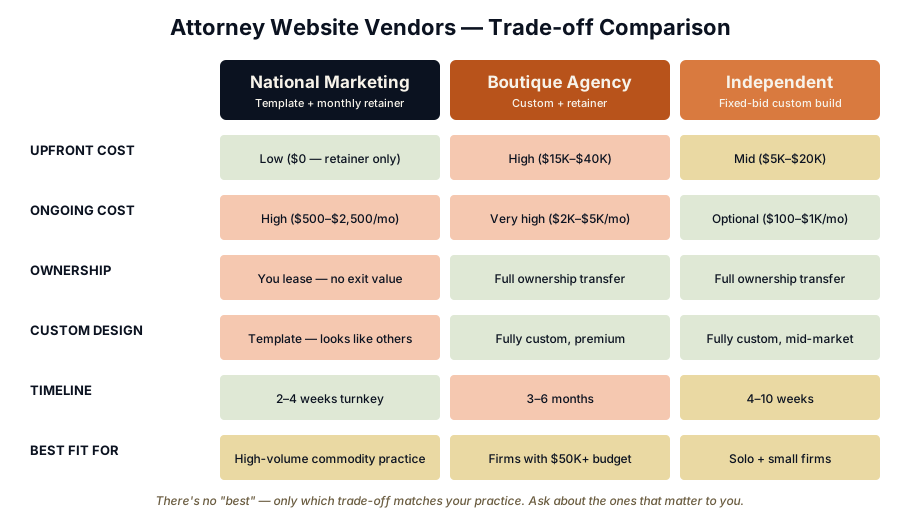
Now that you know the categories, here’s the trade-off framework worth applying to any vendor conversation.
1. Ownership vs. Lease
The question: If you leave this vendor, what do you take with you?
Template services often lease you the site. Leave and you start over. Custom builds (boutique agency or independent) transfer full ownership. If long-term flexibility matters to you, ownership is worth real money.
2. Custom vs. Template
The question: How much does your site need to differentiate from competitors?
For high-volume, low-differentiation practices, a good template may be enough. For practices where you’re competing on sophistication (federal defense, complex commercial litigation, boutique estate planning, high-value trust and estate work) a template site can actively hurt you by making you look like every other attorney in the search results.
3. Ongoing Content Model
The question: Where does the content come from?
- Template services publish generic, ghostwritten content on your behalf. High volume, low uniqueness, and Google can often tell, which is why generic legal content often ranks poorly compared to genuinely expert-authored pieces.
- Boutique agencies produce custom content strategy but bill separately or roll it into a heavy retainer.
- Independent developers typically write less content but higher-quality per piece, or connect you to a legal copywriter for specific pieces.
Ask: how many words per month is included, who writes it, and what’s the plan when the vendor stops publishing?
4. Bar-Advertising Compliance
The question: Who is responsible for content compliance with your state’s attorney advertising rules?
Template services usually take some compliance responsibility: the templates and stock content are pre-vetted against common rules. Custom builds typically put compliance responsibility on you (or your ethics counsel). This matters more if you’re in a strict-advertising-rule state or if your practice touches sensitive areas like personal injury or criminal defense.
Ask: whose contract clause covers advertising-rule compliance?
5. Directory and Network Access
The question: What do you lose by leaving a national platform’s ecosystem?
Some template services own major legal directories and include cross-linking in their retainer. Independent developers can manually submit you to Avvo, Justia, FindLaw’s free profile, state bar, county bar, chamber, and other citations, which covers most of the SEO value but requires the up-front submission work.
Ask: which directory listings will be submitted for you at launch, and which ongoing?
6. Lock-In
The question: How easily can you migrate to a different vendor in year 3?
Template services often lock you in: proprietary CMS, proprietary hosting, contract minimums. Custom builds on standard tech (WordPress, Astro, Next.js, etc.) let you migrate freely.
Ask: what specifically happens if you cancel? What files, credentials, and content do you receive?
Five Questions to Ask Any Vendor Before Signing
Regardless of category, these five cut through the pitch:
- What do I own after we’re done, and can I take it if I leave?
- What’s the total 3-year cost: build plus every retainer plus every ongoing fee?
- What’s included in the retainer, and what’s billed separately?
- Who’s responsible for state bar advertising-rule compliance on the content?
- Show me two sites you built for solo attorneys with a practice similar to mine.
Clear answers to those five questions are what “hiring well” looks like. If a vendor dodges any of them, the answer isn’t a good one.
The Three-Year Cost Frame
Attorney websites are long-term relationships. Comparing on year-one cost alone is misleading. Here’s the frame that actually matters:
| Vendor category | Year 1 | Year 2 | Year 3 | 3-year total |
|---|---|---|---|---|
| National template service (mid-tier) | ~$9,000 | ~$9,000 | ~$9,000 | ~$27,000 |
| Boutique legal agency | ~$25,000 build + $30,000 SEO | ~$30,000 SEO | ~$30,000 SEO | ~$115,000 |
| Independent developer + care plan | ~$12,000 build + $3,000 care | ~$3,000 care | ~$3,000 care | ~$21,000 |
Numbers vary widely. The point isn’t the specific figures. It’s that the total-cost picture shifts dramatically between vendor categories over the actual lifespan of a lawyer’s website (5-8 years is typical between full rebuilds).
Which Fits Which Practice
Honest read:
- A national template service fits high-volume, low-differentiation, cost-conscious practices where “good enough” is fine and time savings matter more than differentiation.
- A boutique legal agency fits multi-attorney firms with real marketing budgets and specific vertical expertise needs (mass-tort personal injury, complex commercial litigation).
- An independent developer fits solo or small-firm practices that want real differentiation and long-term ownership at a mid-market price, especially when the attorney’s practice already has a specific positioning worth building around.
There’s no universally right answer. But there’s usually a right answer for a specific attorney’s specific practice.
The Actual Move
If you’re currently on a template service and you’ve been paying for 2+ years, add up what you’ve spent. If it’s north of $15,000, you’ve likely already funded a custom rebuild that would serve you better and cost you less over the next 5 years. That’s the conversation worth having with your next vendor.
If you’re just starting out and money is tight, a good template service is a reasonable starting point. Just don’t sign a long-term contract that’s hard to leave.
If your practice is sophisticated enough that potential clients evaluate you on how you present yourself online, a custom site pays for itself faster than you’d think.
If you want to talk about which category fits your specific practice, get in touch. Fifteen-minute call, no pressure. I’ll tell you honestly which category to shop in, even if it isn’t me.
Common Questions
Do I really own my website if I use a national legal marketing service?
No. You lease access to a template on their platform. If you leave the service, you typically leave with nothing: no design, no content, no SEO history. That's the trade for the turnkey convenience.
Are boutique legal-vertical agencies worth the higher price?
For firms who want a distinctive brand, can afford $15K–$40K plus a monthly retainer, and value ongoing account management, yes. For solo practitioners on tight cash flow or firms who value ownership over hand-holding, an independent developer on fixed-bid is usually a better fit.
What should an attorney ask before signing any website contract?
Ask about ownership (do you own the site or lease it?), exit terms (what leaves with you?), hosting portability, whether SEO work is included or separate, what happens to your content if you cancel, and how the vendor handles bar-advertising rule compliance in your jurisdiction.
How much should a small law firm spend on a website?
Realistic range is $8K–$25K for a fixed-bid custom build from an independent developer or small studio, plus optional $200–$500/month for ongoing care and content updates. National services run $500–$2,500/month with no upfront cost but no ownership. Boutique agencies run $20K–$50K plus retainer.
Related reading
July 7, 2026
When It's Time to Leave a National Legal Marketing Platform
You've been paying monthly for years. Ranking isn't moving. Here's how to actually leave, without wrecking your SEO, losing your reviews, or getting sued.
July 7, 2026
What a $2,000 vs. a $10,000 Website Actually Gets You
An honest breakdown of what actually differs between cheap and expensive websites: what you're paying for, what's overpriced, and how to pick the right tier for your business.
Have a project this connects to? Let's talk about it.